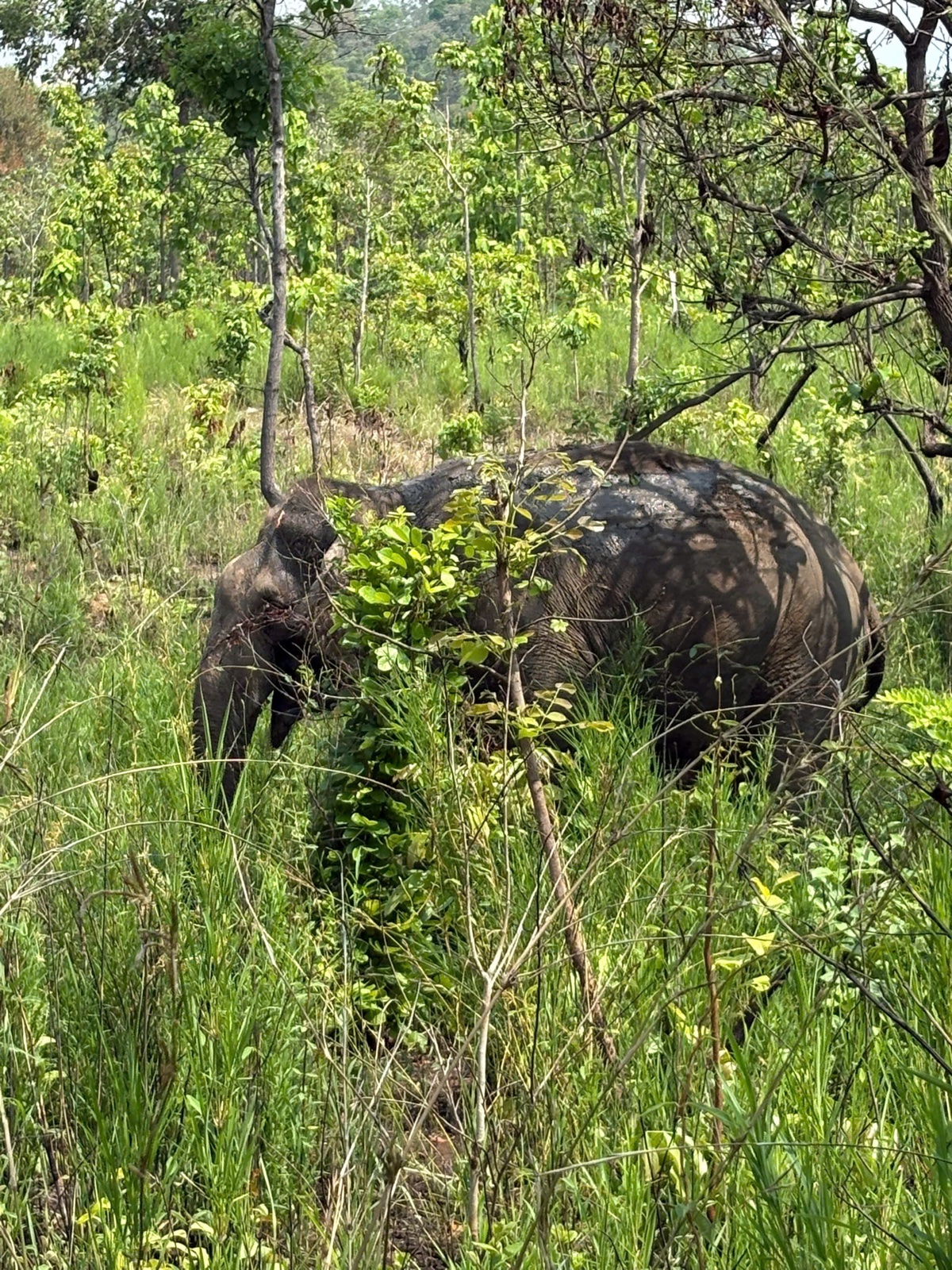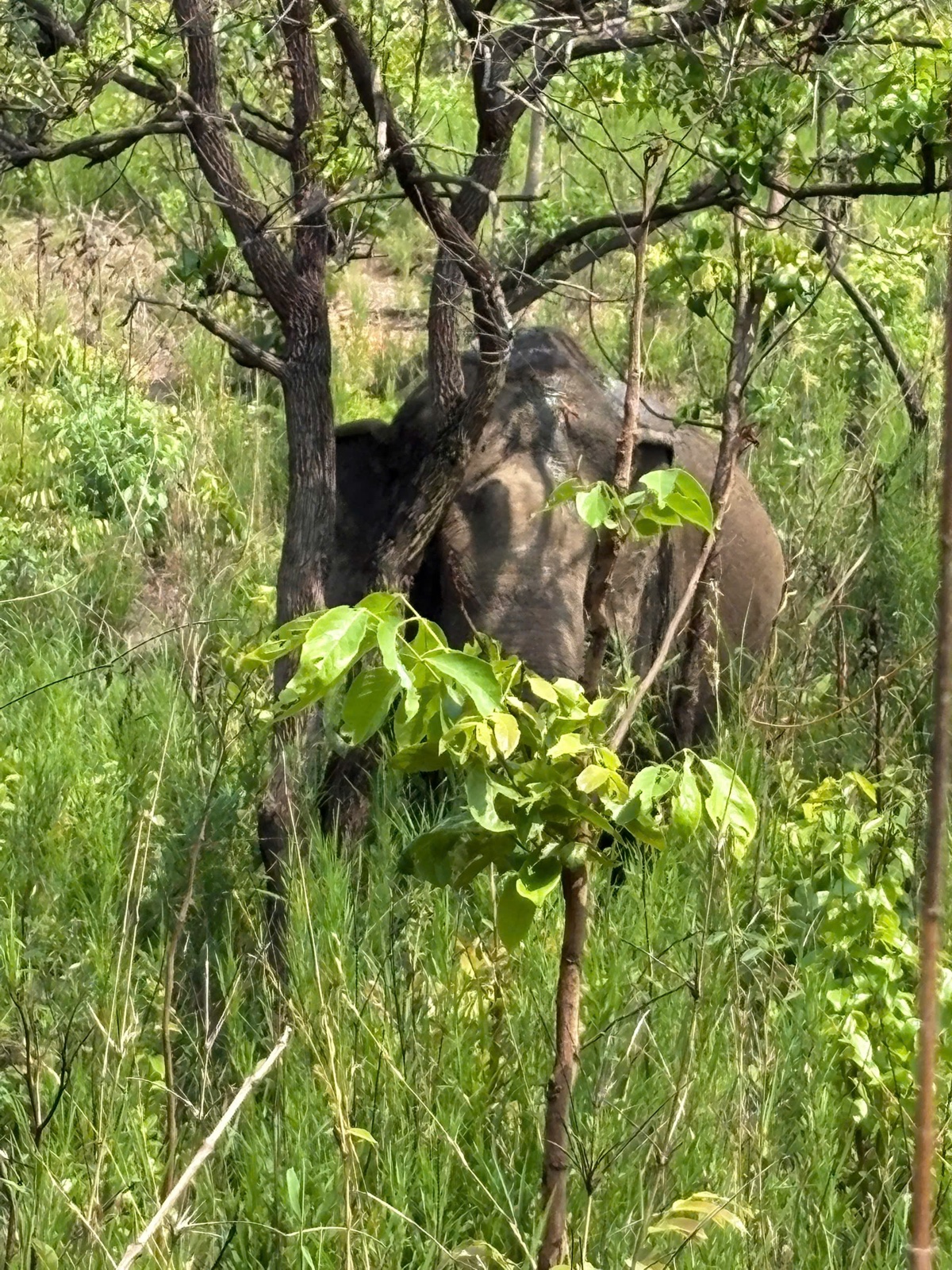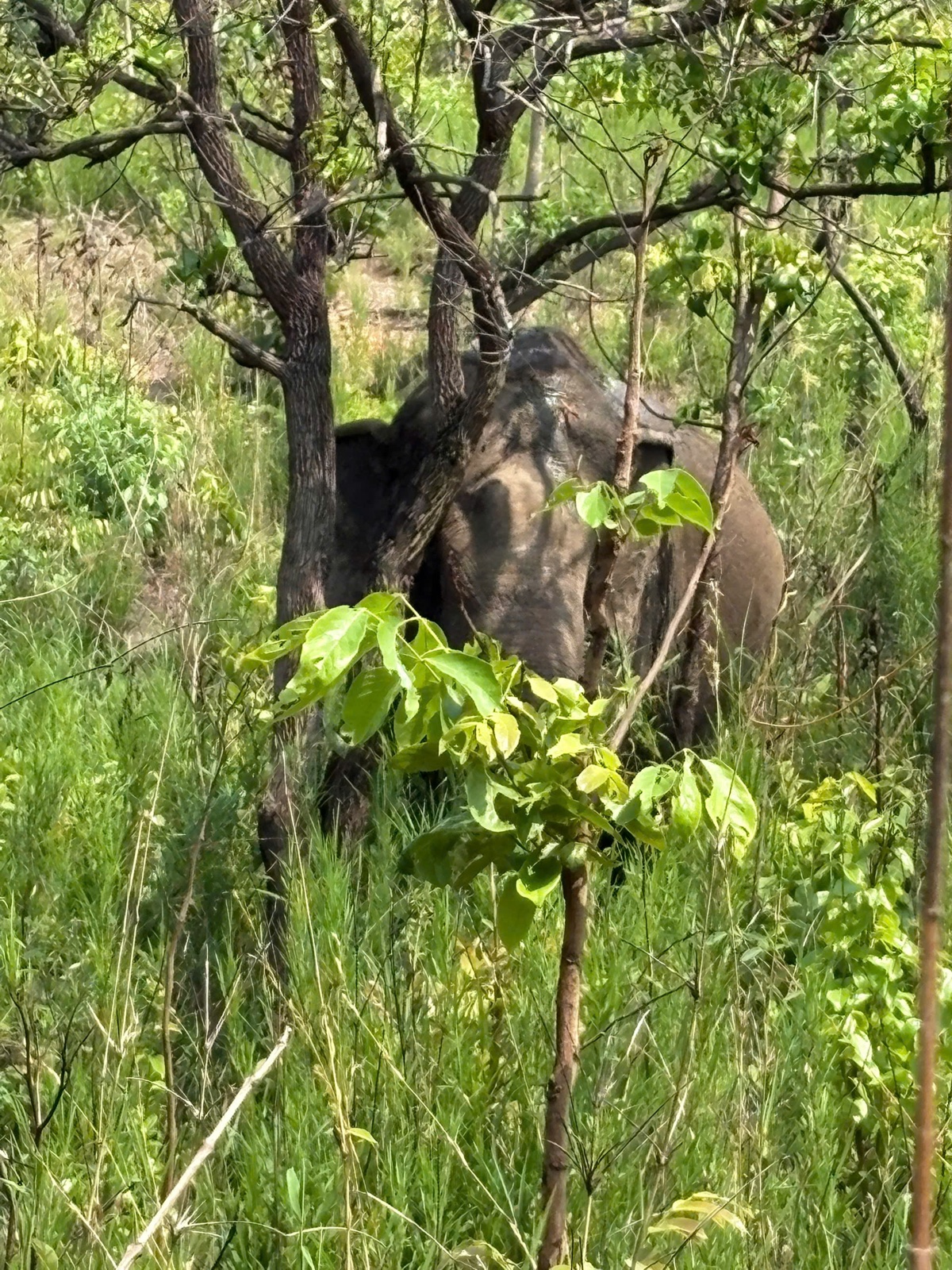
There is a late dry-season afternoon in Đắk Lắk when you stand in the red-earth courtyard of Ánh Dương Eco Tourism Site, about twenty steps from a bull elephant. He is using his trunk to gather a bundle of young bamboo leaves. There is no wooden chair on his back. There is no chain around his legs. There is no one behind him with an iron hook. The gru (mahout) beside him points and gives his name: Y Dor. He is a bull elephant who worked hard for many years, and now he is free to walk into the forest, bathe in mud, and forage by his own instinct. The story of Y Dor being free in the forest is a small one, but it is also an important piece of the longer journey to improve the welfare of captive elephants in Vietnam's Central Highlands.
Y Dor free in the forest after long years of work
Y Dor is an Asian bull elephant. His tusks are still intact, his skin is thick, and his eyelids fold in the way of an elephant who has spent decades in the sun. If you stand close enough to look at his neck and shoulders, you will see the soft marks of an elephant who once worked long routes, a faintly grey band where an old belt strap used to rub, a slight scar across the upper back. Those marks do not tell today's story. They tell the story of two or three decades ago, when riding tourism was the standard model in Đắk Lắk, and an elephant like Y Dor worked from morning until evening on most days of the year.
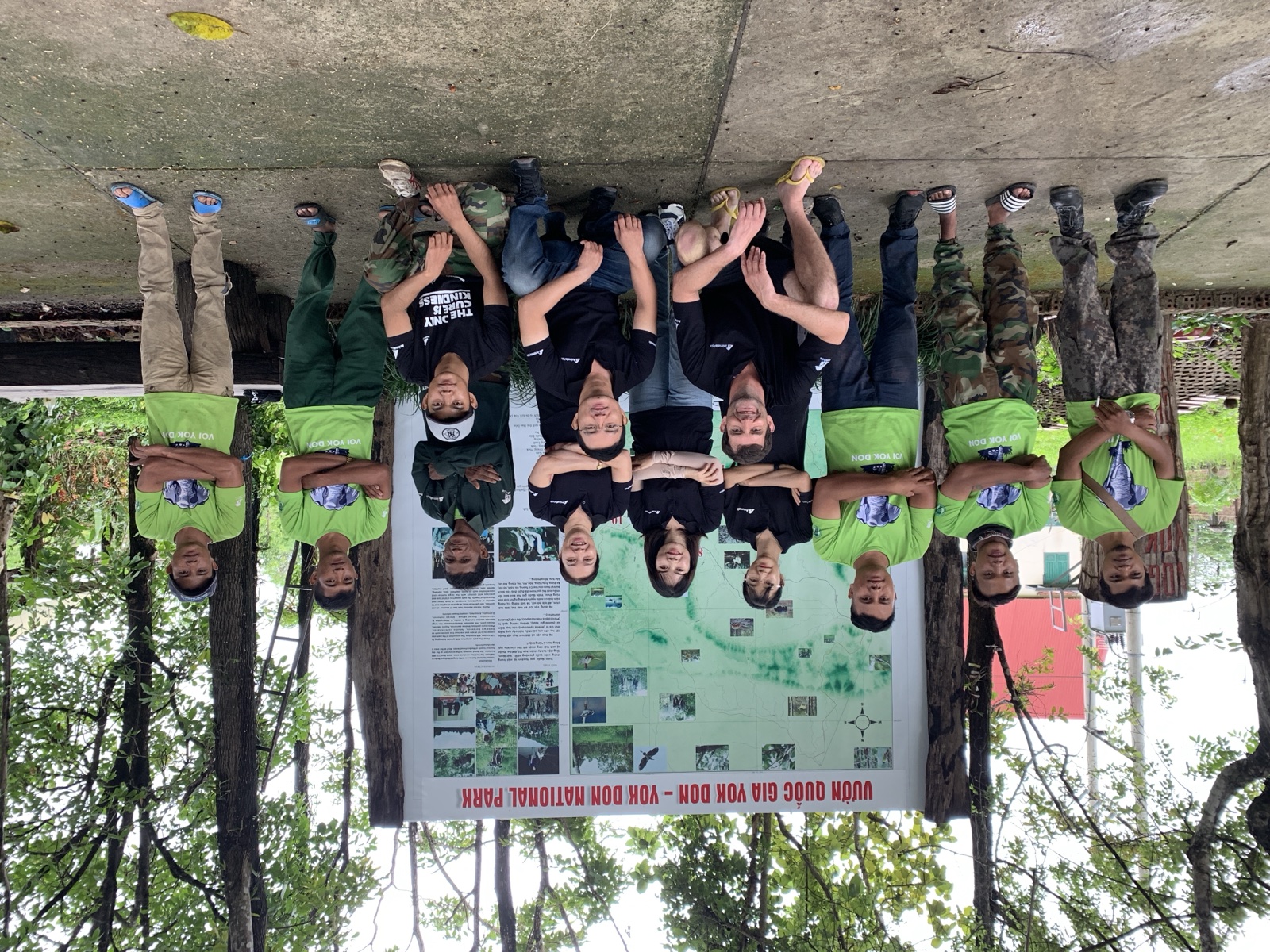
Today Y Dor no longer carries tourists. The gru who has lived beside him for more than twenty years, a M'Nông man whose own father and uncle also kept elephants, decided together with Ánh Dương Eco Tourism Site to change direction completely. The elephant does not carry anyone on his back. He does not drag timber. He does not stand under a tin shelter all day for photographs. Y Dor walks into the demarcated forest of the site in the early morning, eats leaves, takes a mud bath, soaks in a shallow pool, and returns at the end of the day when the sun has dropped behind the tall dipterocarp trees.
The story of Y Dor is not the story of a single elephant. Đắk Lắk now has only thirty to forty domesticated elephants left. Each elephant that transitions from being ridden to being observed is at once an economic decision, a cultural decision, and an ethical decision. Y Dor is one of those who has made it through that transition.

A new day for Y Dor: trunk, water, leaves, and earth
If you stay overnight at Ánh Dương, you will hear Y Dor's rhythm before you see him. Around four in the morning, there is a heavy footstep, the unhurried tread of a four-ton creature, passing behind the wooden stilt houses. The gru is already awake, the small fire is already lit, and he is already standing beside the elephant. The elephant walks into the forest before the site's gardeners have even started their day.
A day for Y Dor follows a simple rhythm, close to the rhythm of a wild elephant:
- In the early morning, from four to seven, the elephant walks deep into the demarcated forest to feed. Young bamboo leaves, dipterocarp leaves, fresh grass shoots, forest bamboo shoots, Y Dor's breakfast can last three or four hours.
- In mid-morning he finds a shallow pool for a mud bath. A dry crust of mud on the skin is the most natural sunscreen and parasite shield an elephant has.
- At noon, from eleven to three, the elephant rests. Sometimes he stands still, head tilted slightly, eyes half closed. The gru sits a few dozen steps away, not calling, not nudging.
- In the afternoon, from three to six, the elephant returns to feed for a second time. This is also the window when guests of Ánh Dương are led in to observe Y Dor, walking parallel to the elephant at a safe distance.
- In the evening, as light fades, the elephant returns to an open shelter. No chain. No locked gate. The shelter is simply a large tin roof to protect him from rain.
Y Dor's total daily intake is roughly 200 to 250 kilograms of leaves, grass, shoots, and a little supplementary fruit. By body weight, an elephant eats more than three times what a cow does. Keeping an elephant is not cheap. Y Dor is kept this way because the site and the gru have accepted a fact: revenue from observation-only elephant tourism must cover the cost of food and labour. That is a monthly arithmetic, not a slogan.
Ánh Dương Eco Tourism Site in Đắk Lắk and a decision with no turning back
Ánh Dương Eco Tourism Site sits in southern Đắk Lắk, not far from Lắk lake, tucked between a strip of open dipterocarp forest and farmland. The area has hosted travellers for many years. In the early phase, the model resembled many other highland destinations, elephants worked, guests climbed onto their backs, photographs were taken under a wide dipterocarp tree. The revenue was fast, easy to explain, and easy to close.
But in recent years, Ánh Dương and several local partners chose a different road. They decided to stop riding and performance activities entirely. They expanded the forest area so Y Dor and a few female elephants from the same village could roam freely during feeding hours. They dug additional pools for elephants to bathe in. They trained two younger gru to observe elephants from a distance rather than stand pressed against them.
That decision was not easy. An elephant who does not carry guests still eats 250 kilograms of leaves a day. A gru who no longer leads ride tours still needs a salary. The site's revenue in the first months of transition dropped noticeably. International traveller numbers grew slowly, but only after word spread, slower than the rhythm of a normal business decision. Ánh Dương accepted that wait.

Why a bull elephant needs to be free in the forest
An adult Asian elephant weighs between 2,500 and 4,000 kilograms. He looks vast, but an elephant's spine is not a flat horizontal beam, it is a row of vertebrae that rise upward, designed to bear the weight of the elephant's own body, not to carry additional load on top for hours at a time. Veterinary studies published over the past two decades by Southeast Asian conservation centres point to three main injury patterns when elephants are ridden routinely: spinal and joint damage, skin abrasion where straps rub, and chronic stress expressed through abnormal repetitive behaviours such as head-bobbing or trunk-slamming.
Y Dor lived through those years. Today, as he walks freely into the forest, his body is recovering in the manner of an older bull elephant. The skin where the old belt sat has grown back its soft hairs. The shoulder muscles are less tight. More importantly, his behaviour has shifted. The gru recalls that in the first months after riding stopped, Y Dor still repeated a slight head-bobbing motion when standing still, a residue of the old habit. A year later, the motion has almost disappeared. When he stands in the forest, he stands genuinely still. When he chews, his trunk moves at an unhurried pace. That is the signal of an animal whose load has, in large part, been lifted.
The decision to let a bull elephant be free in the forest is not a marketing line. It is a concrete chain of actions: buying additional forest land, digging pools, repairing the open shelter, training gru in observation rather than handling, refusing guest groups who want to ride, refusing film crews who want performance. Every link in that chain has a cost. When you come to Ánh Dương and pay for a morning observing Y Dor, part of that payment is exactly what offsets that chain.
"An elephant is not for riding. He is a great friend of the family. The guest only needs to stand and watch him walk, watch him bathe, that is already enough."
Lonature is one link in this journey
Lonature does not own Y Dor and does not operate Ánh Dương Eco Tourism Site. Lonature is a small household business based in Buôn Ma Thuột that works as an agency, we walk alongside local partners in connecting travellers with licensed elephant observation programmes that are transitioning to a no-riding model. In Y Dor's story, Lonature plays the role of one link in this journey: connecting international and conscientious domestic travellers with places like Ánh Dương, and making sure the journey unfolds in the spirit of slow travel.
Each elephant observation programme that Lonature introduces is built on three simple principles. First, the elephant always comes first in the schedule, the elephant's feeding, bathing, and resting hours decide when guests are brought in, not the other way around. Second, no activity requires the guest to touch the elephant: no riding, no climbing onto the back during bathing, no close-up photographs. Third, a portion of the programme's revenue returns to the gru, to the site, and to the fund supporting captive elephant welfare in Đắk Lắk.
Lonature walks alongside partners working on captive elephant welfare in the Central Highlands, supporting families and tourism sites to transition from older riding models to friendly, ethical tourism. Your presence at Ánh Dương is itself a contribution to captive elephant welfare. That is not a slogan, but a specific flow of money into salaries, food, medicine, and forest land.

When you come to observe Y Dor: what you will do, what you will not
An observation session with Y Dor at Ánh Dương typically lasts three to four hours, starting in the early morning or late afternoon. You are introduced to the gru before you meet the elephant, not as a formality, but because the gru decides the day's distance and timing between you and Y Dor based on the elephant's mood. A sixty-year-old bull elephant is not always in the mood for visitors. If Y Dor is sensitive that day, the gru keeps the distance wider than usual.
During the session, you are led into the forest along a track, walking parallel to the elephant. You can stand quietly to watch Y Dor part the leaves with his trunk, sit at the foot of a tree to watch him eat, or help prepare his afternoon meal, cutting sugarcane, bundling bananas, which the gru then carries in. You do not climb onto the elephant. You do not pull his trunk. You do not pose him for a portrait. The safe distance is roughly fifteen to twenty steps, and that distance is set by the gru.
The session usually ends at a small pool inside the forest. Y Dor steps into the water, comes out, splashes water across his back, stands still for a moment, and walks deeper into the forest. You stay on the bank, watching. Some guests take a photograph. Some do not. There is a sentence many international guests say afterwards: the strangest feeling is not watching a free elephant, it is realising you do not need to do anything to make the morning meaningful.
That is the real moment of slow travel. You do not add a new check-in mark to your list. You give time to another creature. You let the elephant move first, behind, alongside, in the way he chooses. When you leave Ánh Dương, Y Dor is still there, still walking into the forest, still bathing in mud, no different from the day before you arrived.

A small piece of the future of captive elephants in the Central Highlands
The story of Y Dor does not end with a grand statistic. Đắk Lắk still has many elephants caught between two models. Some have stopped carrying guests but still stand under a tin shelter all day. Some still carry guests in tourism festivals in nearby districts. The province's transition is not a matter of one policy round. It is a chain of small decisions, household by household, site by site, year by year.
In that chain, Y Dor is one piece. Every traveller who chooses observation rather than riding, every group that pays for captive elephant welfare rather than performance, every family conversation about whether to book a ride, together they are rewriting the future of the last domesticated elephants of the Central Highlands, one line at a time. When you come to Ánh Dương and meet Y Dor, you are writing a small line in that story.
There is one more thing worth saying. Y Dor's story belongs to a wider, slow movement across Đắk Lắk and parts of Southeast Asia. Each ethical site that opens, each gru who chooses observation over the old model, each younger gru who learns to read elephants from a distance rather than handle them up close, all of these are small chapters in the same book. The book has no publication date. It is being written by readers who pay attention, by visitors who choose carefully, and by communities who refuse to forget that an elephant is, before anything else, a sentient creature who would rather walk into a forest than stand under a chain.
If you would like to join a no-riding elephant observation session in Đắk Lắk, you can begin with the Lonature elephant experience programme, or read more about how Lonature walks alongside local partners. If you cannot arrange a trip to Đắk Lắk this time, one small action still helps: share Y Dor's story so the idea of observation rather than riding moves another step forward. Reach out via [email protected] to plan a slow-travel itinerary in Đắk Lắk.