Cơm lam và bếp lửa rừng — bữa ăn không cầu kỳ ở Đắk Lắk
Trải nghiệm

Cơm lam và bếp lửa rừng — bữa ăn không cầu kỳ ở Đắk Lắk

10.05.202610 phút
Back to blog

Cơm lam Đắk Lắk nấu trong ống tre tươi, một món thịt nướng, một bát canh lá rừng và bình rượu cần — bữa ăn rừng khộp đặt ra một giới hạn để vị từng nguyên liệu nổi rõ.

There is a very specific moment at every overnight in the dipterocarp forest of Đắk Lắk when you are hungry but not in a rush. It is around five thirty in the afternoon, the sun has dropped behind a row of dipterocarp trees, the fire at the center of camp is burning steadily, a fresh bamboo tube is propped beside the embers, and you sit on a flat rock knowing your portion of the meal is cooking at exactly the speed of the flame. This is the moment a forest meal begins to feel different from any meal you have had in the city.

Why a meal in the forest is unlike a meal in a restaurant

A forest meal in Đắk Lắk is not about elaborate cooking. It is about the rhythm of the meal. In a restaurant, the meal compresses into a single hour. You arrive, you order, you eat, you pay, you leave. Every step is performed by someone else, every ingredient was prepared in advance, and you see nothing of what happens between ordering and eating.

A meal in the dipterocarp forest is the opposite. You see the entire process. The wood that is burning is wood you collected with the guide. The bamboo tube cooking the cơm lam (rice steamed inside fresh bamboo) is the tube you saw cut earlier in the afternoon. The forest leaves in the soup are leaves the guide named for you on the way in. Each ingredient has a traceable origin, and you witness it.

This is something Lonature partners deliberately keep unchanged. At every overnight camping program run by local partners, dinner is still cooked on a single fire at the center of camp — no gas stove, no rice cooker, no microwave. This is not for rustic theater. The single fire is the gathering point of the whole group, and the most memorable conversations of the evening happen within three meters of it.

A typical dipterocarp forest dinner with a Lonature partner has four basic parts: cơm lam, one grilled meat or fish, a bowl of forest-leaf soup, and a small jar of rượu cần (communal rice wine sipped through long bamboo reeds). Sometimes a small dish of hand-ground forest chili salt. That is the whole menu. No starters, no dessert. The food is laid on a single large banana leaf placed on the ground, and people sit around it — no individual plates, no cutlery.

This simplicity is not scarcity. It is the way a forest meal sets its own boundary, and that boundary is exactly what makes the flavor of every ingredient stand out far more clearly than it ever does in the city.

A dense thicket of dry lồ ô bamboo in the dipterocarp forest of Đắk Lắk
Dry bamboo grove · Tây Nguyên

Cơm lam: the technique hidden inside a fresh bamboo tube

Cơm lam is far better than people who have never tasted it imagine. This is not rice cooked in bamboo for novelty. It is a cooking technique with hundreds of years of history among Central Highlands communities, and every step in the process has a reason.

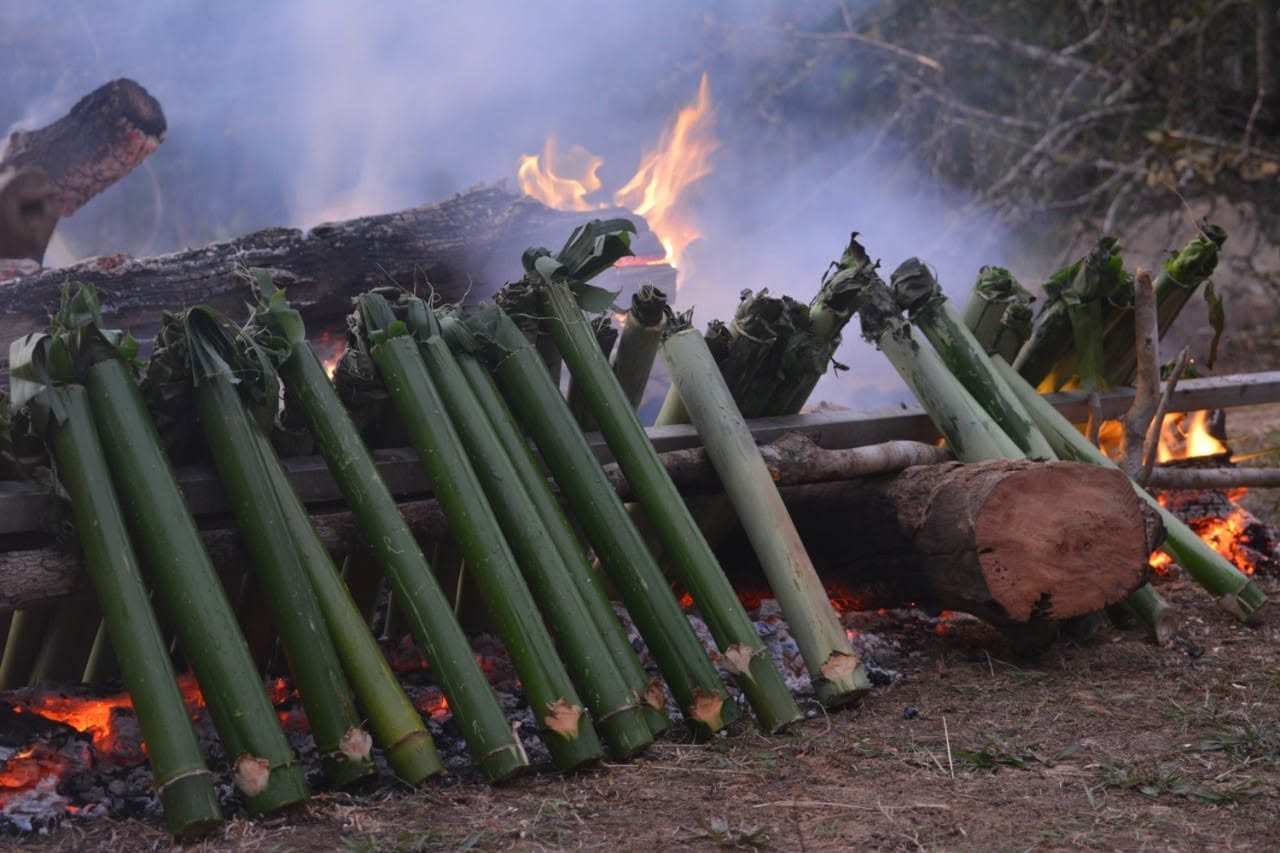
It starts with the bamboo. It must be fresh lồ ô bamboo, about five to seven centimeters in diameter, the joint still green, the cut surface still wet. No one makes cơm lam with dried bamboo. Fresh bamboo holds water inside while it heats, and that water passes into the rice grains together with a faint scent of bamboo — a scent no packaging or pot can replicate. An experienced M'Nông guide picks tubes that are not too old, avoiding ones with thick outer walls but hollow gaps inside that would leave the rice unevenly cooked.

The rice should be hill rice, with shorter rounder grains than lowland rice. Hill rice grows on the slopes farmed by Ê Đê and M'Nông communities, with little chemical fertilizer, and is naturally chewy. The rice is rinsed lightly, soaked for about twenty minutes in cool stream water — not washed thoroughly, because the thin bran layer that gives the cooked rice its fragrance must be preserved.

When pouring the rice into the tube, the amount of water must be just right — about a finger joint above the rice level. Too much, and the rice goes soggy and the tube splits early. Too little, and the rice is undercooked in the middle. A fresh banana leaf is rolled into a plug to seal the open end of the tube, and the tube is then propped at an angle beside the bed of red embers — never standing upright, never lying flat. The angle helps heat distribute evenly along the length of the tube.

After about forty minutes, the bamboo skin chars where it touches the embers, and a small wisp of steam rises from the open end. This is when the rice is done. The guide taps the tube and listens for a dense thud — meaning the grains have absorbed all the water and there is no soggy excess inside. You take the tube out, let it rest for ten minutes, then peel the bamboo skin away by hand.

The most enjoyable part of cơm lam is the moment of peeling. The tube is split lengthwise into quarters, revealing a cylinder of cooked rice with a thin silken layer from the inner bamboo wall still clinging to it. That silken layer is edible, faintly sweet and faintly bitter — and that is exactly why cơm lam tastes nothing like rice cooked in a pot. The rice inside is sticky, pale gold, with a hint of woodsmoke and a very gentle bamboo aroma.

The traditional way to eat: peel off a finger-length section, dip it into sesame salt or forest chili salt, eat with your hands. No chopsticks, no plate. This is the kind of rice that can make even a fast eater slow down — because peeling, dipping, and lifting takes longer than scooping a spoonful of plain rice.

Camping site with three tents and a stack of firewood in the dipterocarp forest of Đắk Lắk
Camp setup in the dipterocarp forest · Đắk Lắk

Dinner around the single fire

Beside the cơm lam, a typical dipterocarp forest dinner includes one grilled dish. The most common is gà nướng ống tre (chicken grilled inside a bamboo tube) — a small free-range chicken, cleaned, marinated with rock salt, wild lime leaves, crushed lemongrass, and ground forest chili, then placed inside a tube larger than the rice tube and propped beside the embers. After forty-five minutes, the skin is golden, the meat is tender, and the lemongrass and lime have soaked through evenly.

Sometimes the local partner switches to thịt heo bản (free-range mountain pork). This pork has firmer fibers than commercial pork, less fat, and a natural sweetness. The meat is cut into small cubes, marinated with chili salt and forest leaves, then clamped between two split bamboo sticks and grilled directly over the fire. Fat drips into the embers and creates a soft smoke, and that smoke imparts a flavor that a gas stove will never produce.

Forest-leaf soup is the part that gets the least promotion but tends to stay longest in guests' memory. Some partners use cà đắng — small round green eggplants with a faint bitter note, simmered with dried shrimp and wild taro leaves. Others cook canh lá nồm — a soup made with leaves that have a soft sour flavor, used instead of tamarind. Both are cooked on the same single fire, in a small cast-iron pot resting on three stones. There is no instant seasoning, no MSG packets — only rock salt, cane sugar, and occasionally a bit of fermented rice mash.

"The best meal of my life was a bowl of bitter eggplant soup in a dipterocarp forest in 2026 — I do not remember the price, because there was no per-bowl price."

One detail Lonature often hears from guests: many eat less than they would in the city, but feel full longer. The reason is not just the freshness of the ingredients. The reason is that when you sit around a fire, eat with your hands, and have someone next to you, you chew more slowly, you pause more often, and you actually notice the flavor of what enters your mouth. The brain has time to register fullness on time, instead of being tricked by speed.

Rượu cần and the rhythm of sitting still together

After the main course, the partner usually opens a small jar of rượu cần. The jar is a low ceramic vessel with a wide mouth, filled with a mixture of fermented rice and forest yeast that has aged for several months. A series of long bamboo reeds about half a meter long pierces through a banana-leaf cover — that is how you drink. Hot water is poured into the jar from above, flows through the fermented rice, and pushes up through the reeds, becoming wine by the time it reaches your lips.

Rượu cần in Đắk Lắk is not strong. A small jar shared among five or six people takes about thirty minutes to finish, with each person sipping a few times. The flavor is faintly sour, faintly sweet, with a gentle aftertaste like a fermented tea. This is not a drink for getting drunk. This is a drink for slowing down — you cannot drink fast because the reed is long and the amount of wine drawn per sip is small.

Around the rượu cần jar, people are usually quiet more than they speak. A M'Nông guide may sing a short folk song about mountains and forests. Sometimes there is no song, only the sound of fire popping and the dipterocarp wind passing through. This is the part of the forest meal that most city guests, after they return, say they have never experienced in any restaurant — not because the dishes were exotic, but because this rhythm of sitting still does not exist in urban dining culture.

A guide once said: in old M'Nông life, no one ate alone. A meal was a community event, even if it was just three people in the forest. Today, in the city, many people eat alone every day — office lunches, dinners in front of a screen. A dipterocarp forest meal in Đắk Lắk, very gently, reminds you that eating together does not need a special reason.

A red dirt road through the dipterocarp forest in early dry season Đắk Lắk
Forest dirt road · Đắk Lắk

Five points to note for your first forest meal

Before joining a camping program with dinner in the dipterocarp forest of Đắk Lắk, here are five points to make the first time more comfortable.

  1. Mention any allergies in advance. Bitter eggplant, wild taro leaves, lemongrass, forest chili — all are local ingredients. If you are allergic to any of them, tell the guide as soon as you meet so the partner can prepare a substitute dish.
  1. Bring a small towel. You will eat with your hands more than you expect. A small towel is much more practical than store-bought wet wipes, and produces no waste.
  1. Do not rush the guide. Cơm lam takes forty minutes. Bamboo-tube chicken takes the same. Use that window to walk around camp, sit with a notebook, or simply do nothing. Rushing breaks the rhythm.
  1. Drink rượu cần the proper way. Sip slowly through the bamboo reed, do not try to drain it quickly. One long sip, pause, share a sentence, the next sip. This is not a drink for fast consumption.
  1. Bring water. The meal is saltier than restaurant food because rock salt is used. One liter of plain water per person is the minimum.
"A good forest meal is when you sit down hungry and stand up not remembering how much you ate, only who you sat with."

If you want to try your first forest meal, you can begin with Lonature's 1.5-day walk-and-camp program, where the cơm lam dinner is cooked exactly according to the process described above. Or read more about one night in the dipterocarp forest to picture the full rhythm of a camping evening from afternoon to morning. Reach out via [email protected] to plan a slow-travel itinerary in Đắk Lắk.

Ẩm thựcCắm trạiTây NguyênCơm lam